Tackle Box Brewery
Full production design for a live music venue—lights, sound, and stage.
The Challenge
The Problem
A local brewery wanted to host live music and had minimal production infrastructure. A 7 inch tall stage that could only hold a drumset OR an acoustic trio, a couple of lights hanging from questionable chain, and no sound system—just a big room with great beer.
Why I Took This On
The owners were friends, the space had potential, and I'd been itching to design a venue system from scratch rather than work around someone else's legacy setup.
Constraints
No budget, needed to be modular for different act sizes, and couldn't permanently alter the building structure.
The Process
Initial Approach
Started with the sound system since that's the foundation. Mapped the room acoustics and designed a scalable PA setup.
What Went Wrong
Made a rookie mistake when placing the new speakers. Mounted them to the wall for great room acoustics (I came from a DJ background) and quickly discovered that speakers *behind* the band's microphones was a giant no-no. Had to rethink fixture placement entirely after the first few shows.
Breakthroughs
At one point, I had been purchasing lighting equipment one or two pieces at a time across Facebook Marketplace over the course of six months. One day, I happened across an entire collection of truss for sale at a price I couldn't pass up. This changed everything.
The Solution
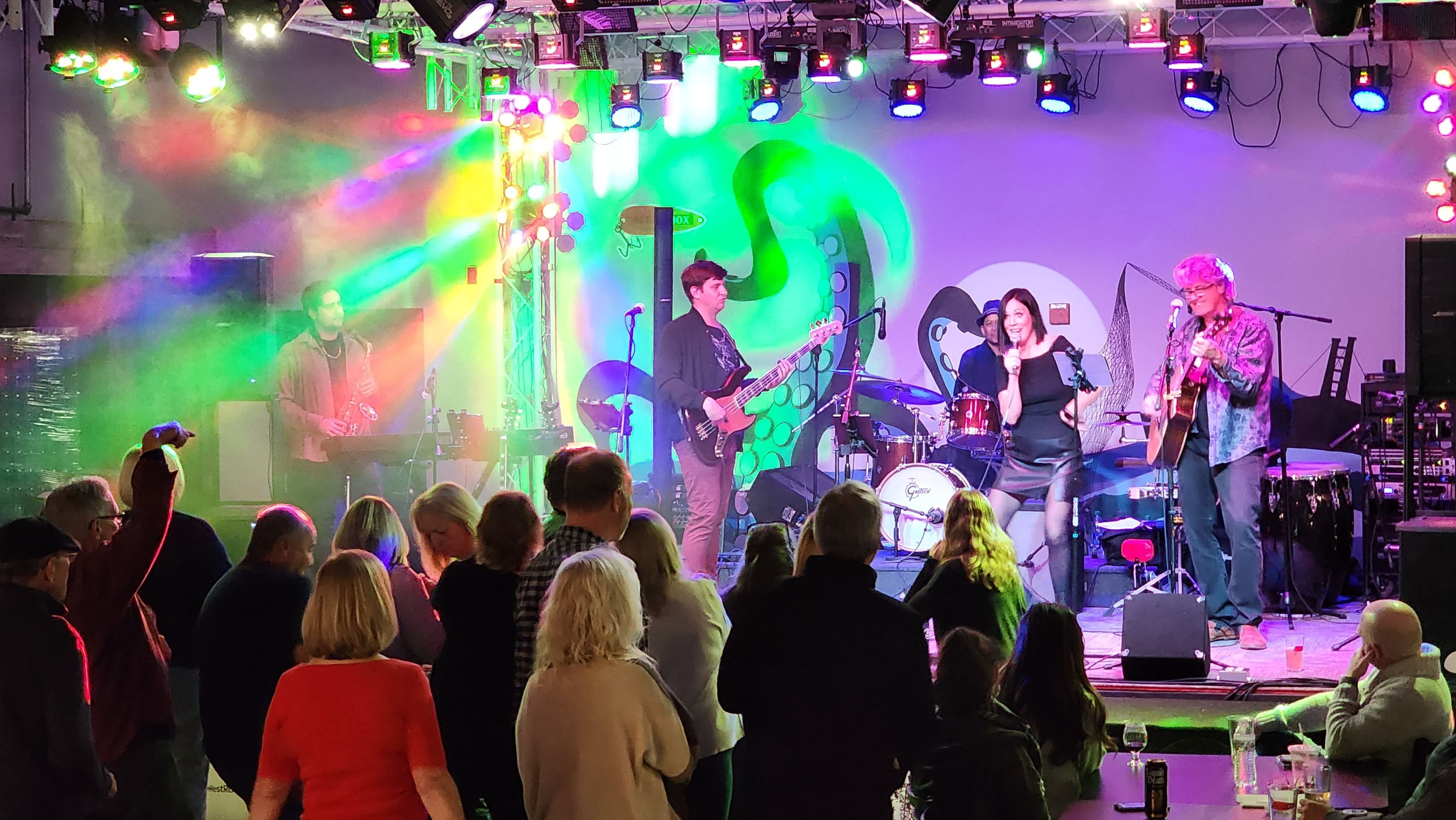
We went from speakers set out on the floor (in front of the band) and a few lights hanging to a full-on stage plan with truss and a lighting system that took advantage of the sheer scale of the venue.
With 12-foot ceilings, and 16,000 square feet of available space, I went to work. Enlisting the help of my best friend Topher Morris who designs sets for a living, we talked design. We made a plan. He made actual plans. With those plans in hand, I went off to see the building department of Marlborough, MA.
The approvals were swiftly granted, and we went all in!
A full-on sixteen foot by twenty foot stage that was actually stage height suddenly appeared. And by appeared, I mean that we spent several days cutting lumber, fireproofing it, and building away.
From there, we built and hung the trusswork from the building's enormous ceiling trusses using professional clamps and shackles. With two pillars in the back corners of the stage, the grid across the ceiling came out a full twenty one feet and was the full 20 feet width of the stage and then came the real work.
Each of the 56 lighting fixtures was hung. And connected to power. And wired for DMX. This was all routed to the new 12x6 foot Front of House sound booth which held not only the computer that controlled the lighting via Onyx, but the Behringer X32 sound board, and a host of other production items.
The stage got a full host of sound gear including a stack of 6 stereo power amps from QSC and Crown, an enormous pair of dual 18" Yamaha subwoofers, and a pair of 15" RCF subwoofers.
Between these, a set of 7 stage monitors, and copious mics, cables, accessories, stands, and gear, I suddenly had a venue that could truly host bands as opposed to giving them a space to set their stuff in.
It was a concert venue in a box. Instead of having to lug their own PA system, and whatever lights they had, bands could show up with their instruments in a super easy load-in, set up, and start playing because I was the house sound engineer and ran the show three nights a week for all the bands.
What I Learned
Skills Gained
Unexpected Discoveries
When I was considering the logistics necessary for building everything, working with the city was the furthest thing from my mind. There was so much that I learned about the process for getting approvals, and what was required from a certification standpoint, that I was well and truly shocked. The city of Marlborough - specifically Tin and Bill - were fantastic to work with and they helped me understand and meet the requirements that the city needed in order to get the stamp of approval.
What I'd Do Differently
I wouldn't actually do too much differently. It worked out really well and I learned ALL kinds of things about so many disciplines. At the end of it, I would have gone for a speaker system that could also be hung from the ceiling. Getting everything up and out of the way and further in front of the band, would have made for a better sound system experience, and helped with the feedback challenges presented by a room with such challenging acoustics and hard reflective surfaces.
Where It Stands Now
Current State
This has been all dismantled and is currently set up in my office in a state of extreme overkill for studio and podcast lighting. After building up the venue and the caliber of bands for nearly two years, the venue thought that it was going to go out of business. 9 months later, they have managed to stave off the closure that is affecting so much of the brewing industry with the assistance of a few investors, and it looks like I will have to shelve my music/entertainment venue dreams until I find another suitable space.
What's Next
I'm looking for the right place to open my own venue with an entertainment centric focus.
The Bigger Picture
This is basically a prototype for the venue I want to own someday. Every problem I solve here is research and development for the next venue!
The Impact
Client Results
Tackle Box Brewery
They went from fun local bands that would bring anywhere from 5 to maybe 30 or 40 people with no cover, to being able to host bands with huge followings and selling out the venue. Instead of paying out $250 to a local band, they were keeping 20% of $3,000 in ticket sales and absolutely crushing the numbers at the bar. The shows were top-notch production and had the ability to handle multi-band festivals and fund-raisers.
Personal Impact
A real-world production lab where I can experiment with new techniques and gear.